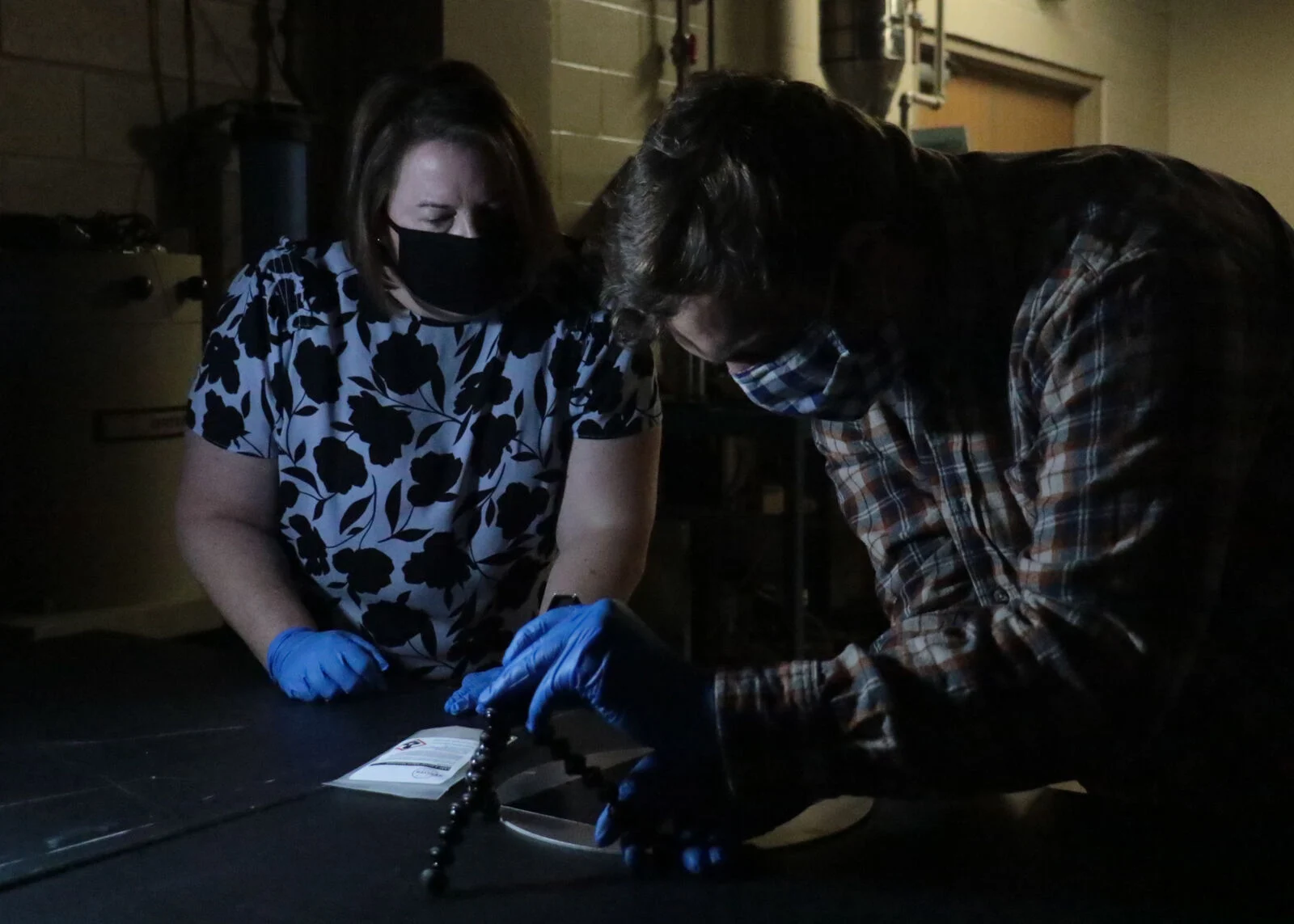
Physics professor Kerri Donaldson Hanna (left) and Adam Bedel (right), a senior physics major, study make a thermal infrared measurement of samples related to the moon. The physics department is focusing on research about the moon and after submitting a proposal to NASA, professors get their project approved.
Courtesy of Kerri Donaldson
When two UCF planetary professors submitted their project to explore the moon to NASA, they never imagined how big it would be.
“We are still kind of in that shock state of being selected,” assistant professor Kerri Donaldson Hanna said.
Donaldson Hanna, along with Adrienne Dove, another assistant professor from UCF's physics department, received a $35 million grant from NASA after they submitted their project to explore the moon. They sent the proposal in December 2021 and it was approved June 2022.
The pair proposed an instrument suite that is going on a rover and also on a lander to a location on the Moon. The lunar surface the instrument is landing on has a very unique volcanic origin with compositions similar to the volcanic domes on Earth.
“We are going to rove rope about the surface and try to determine the composition of the volcanic feature that we’re going to land on,” Donaldson said.
Donaldson said that NASA is going to land the project at the surface of the moon in 2026. In this mission, the robot will land on a part of the moon that has never been visited before: the Gruithuisen Domes. NASA selected the landing site because it has a very unique origin, and there are some possibilities for using some of the materials for future resources.
“It’s really interesting to just think about how the moon evolved as a planetary body over time," Donaldson said. "But then also understanding if we can use any of those materials for future resources for human and robotic exploration will also be really cool."
Joshua Colwell, professor and chair of the department of physics, said that the project is a significant step forward in UCF’s long tradition of space science research. For the first time, a UCF scientist will be the leader of a mission to another world.
“I’m confident that we’ll be leading many more missions and instruments sent into space in the years ahead,” Colwell said. “It’s exciting for our faculty and our students to work on a mission going to the surface of the moon at a time when there is so much attention and activity on exploration of the moon.”
UCF physics professor Adam LaMee is also part of the project. He said that his job is to coordinate the education and outreach. LaMee said they plan on having K-12 teachers involved in the project, participating in the lab by helping test, prototype, calibrate and sample things.
“Right alongside the scientists that are working on this all the way to developing some materials that teachers everywhere can use with their science or math students to learn about physics and planetary science on the moon and why we think it’s cool and what are some of the things that we had to do to make this project happen,” LaMee said.
Homero Rodriguez, a physics minor, said that the physics department currently has great research happening in different fields of study. He said that the grant given by NASA is well deserved because the university's research teams are outstanding, and it is important if UCF wants to continue to pursue space and interplanetary explorations.
“I think that this research is very important; it would be the first step to something bigger, not only for our university but for the United States,” Rodriguez said.
Donaldson Hanna, Dove and LaMee said that there is a lot of planning and steps to do, but they are excited about what is to come.
“That was really big," LaMee said. "I mean, again, my part is small. You know, just one piece of the whole thing.
"But a $35 million NASA project to put a robot on the moon — that doesn’t happen just every day to everybody. So yeah, that was big. Kerri, Addy and I went out to celebrate pretty soon.”