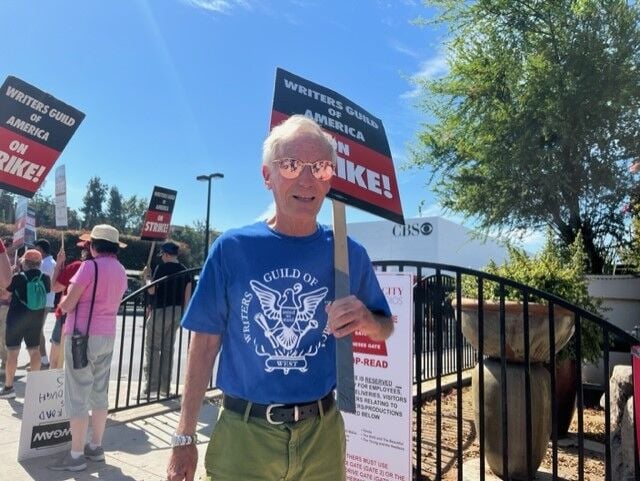
Professor Barry Sandler, member of the Writers Guild of America, stands on the the writers strike picket line in LA last summer. The strike has been going on for the past four months and Sandler said they won't stop striking until they get a fair deal.Courtesy of Barry Sandler
Writers Guild of America screenwriters have been on strike since early May and the union shows no sign of giving up anytime soon, according to an announcement made by the WGA.
Going over 120 days, the union continues to fight for better working conditions in Hollywood's entertainment industry. The Alliance of Motion Pictures and Television Producers, an association that represents various different television and film production companies, is responsible for negotiating with different groups in the entertainment industry, including the WGA.
Barry Sandler, associate professor of film and mass media, is a member of the WGA and has been protesting on the picket lines during the summer.
“You go on strike because, as writers, we create the material, we are the ones who should benefit from it as well as producers and directors,” Sandler said.
The WGA is a labor union that represents writers who write scripts ranging from movies and television, series, documentaries and news programs. It is responsible for making sure writers get credit, residual payments and more for their work.
Sandler also said he has been involved in other strikes with the WGA. As a screenwriter and a member of the WGA for many years, he said when the union goes on strike, it's for a specific reason.
Sandler said writers are striking for various different reasons, one reason being the rising popularity and easy access to streaming services.
“Streaming is revolutionizing the industry now,” Sandler said. “Writers are not getting the same kinds of residual payments they had in the past because there is no way to compute it.”
Another reason for the strike is minimum writers' room staffing for TV shows, he said. The number of staff writers has been severely cut down in size, Sandler said.
“There used to be seasons where that would be 22 shows," Sandler said. "Writers rooms were staffed to write these 22 shows. Now these limited series in streaming are eight shows, 10 shows and sometimes there is one writer, maybe two writers.”
Sandler said screen writers are fighting and feel very strongly that there is a need to have a minimum of eight or 10 writers staffed in a writers' room. Otherwise, a lot of writers will be out of work and a lot of them depend on these staffed positions to make a living.
An additional reason, Sandler said, is the increasing usage of artificial intelligence. The WGA members are worried that studios will use artificial intelligence to write television or movie scripts, he said.
“Writers are demanding that if studios are to do that, then writers are to be involved in this process,” Sandler said. “And that the writers get the credit and not the AI, ChatGPT.”
Sean Mondesire, an assistant professor at the School of Modeling and Simulation, works directly with artificial intelligence and said that the WGA's strike is justified. He said that, as a writer, he would be very concerned because AI continues to get more popular.
“Anybody can create a script from it," Mondesire said. "They just have to give the AI some guidance on what they want that story to be about,”
Mondesire said that AI doesn't necessarily require someone who is a veteran writer or someone who's been in the industry for a long time to write a good script.
“Because that's so easy to generate, maybe you don't need to have a room full of writers,” Mondesire said. "Maybe you can have one lead writer who's interacting with the AI, and then suddenly, you lose all of those jobs.”
Despite this, he said that there is also a positive side to using AI, like giving people access to knowledge.
“So maybe there's an area that you don't know about," Mondesire said. "Or maybe you wanted to write in a different kind of tone, or something like this. You have a tool right next to you that you can easily access that will be able to maybe improve your writing."
However, Mondesire said that he suspects AI's writing quality in screen writing to be lower and less relatable than human writers, especially those who know what a particular show is about.
Sandler said that AI will never produce the same quality of work as humans. He said the reason movies and TV shows are good is because writers establish a human connection with the viewer.
“I don’t think a robot will ever be able to do that,” Sandler said. “It's that emotional pull that makes this emotional connection with the viewer that makes them relate with the characters.”
Sandler said that there is a lot at stake and that is one of the main reasons why screen writers have been on strike for nearly four months.
The last time the WGA went on strike was in 2007. That strike lasted 100 days. The union was anticipating the takeover of streaming markets, just when it was being introduced to audiences, according to the WGA's website. The WGA noticed that writers' compensation were being negatively impacted every time a new medium for content was being introduced.
On Aug. 11, AMPTP released a press release with the proposals they offered for WGA members. According to the document, the association is willing to increase compensation by a compounded 13% increase and that an AI generated script will not be considered literary material. AMPTP is willing to offer a new structure to train writers to become new showrunners in the future, which it would guarantee the time of employment.
“Our priority is to end the strike so that valued members of the creative community can return to what they do best and to end the hardships that so many people and businesses that service the industry are experiencing," said Carol Lombardini, president of the AMPTP. "We have come to the table with an offer that meets the priority concerns the writers have expressed. We are deeply committed to ending the strike and are hopeful that the WGA will work toward the same resolution.”
Despite the proposal, AMPTP has not met the demands made by the WGA so far, according to an announcement made on Aug. 24 by the WGA.
Lucas Tameirão, senior film major, said that he supports the cause. He said that he believes workers are taking action and fighting for their rights.
Tameirão said that he hopes the strike lasts until both the screenwriters and the actors get a fair deal, even if that means bringing productions to a halt.
"We must not forget that what's at stake is the well-being of thousand of people who effectively keep the industry on its feet, but are incredibly under valuated by their contractors," Tameirão said.
He said that students should also understand the political dimensions of the work field.
“Future students need to know about the social dynamics, what are their real interests, who are on their side and who are not,” Tameirão said. “Although I think it is not limited just for the film area.”
The Screen Actors Guild and American Federation of Television and Radio Artists have also been on strike, alongside the WGA. The union has been on strike since July 14, according to an announcement made by the SAG-AFTRA. The SAG-AFTRA is also protesting for their own rights, challenging issues such as as increase in wage and protection of image to prevent AI replacement.
Alyne Montenegro, senior theater studies major, said that she supports the strike. If writers, editors, directors and others in the industry stop working or producing content, eventually producers will need to make a deal. Otherwise, there won't be any movies to watch anymore, she said.
Montenegro said she supports the strikes and has hopes of joining the union in the future.
“I support because my goal is to get into the SAG-AFTRA one day, and if I am going to join them, then I would also like to have the same rights,” Montenegro said.
She said that may prove difficult because after graduating college, she doesn't want to book a job that goes against what the SAG-AFTRA is protesting. She said such complications could affect her chances of entering the organization.
Sandler said although producers have made some offers, it isn't nearly as comparable as to what the WGA members are demanding.
“We continue to hold down," Sandler said. "And the writers are not going to give in. Sometimes the producers say: 'We are just keep going, they will finally break down and are not gonna take it anymore', but it's just the opposite. The longer we are on strike, the more committed we are to get what we want.”
He said that when he was protesting on the picket lines, he was very happy to see the support of the community. Not only did he see writers and actors, but other unions and guilds too, such as the Directors Guild of America.
Sandler said that eventually producers will have to compromise because soon, they will not have a lot of entertainment or media to release across different mediums.
“Pretty soon they won’t have shows to show on the networks or streaming,” Sandler said. “They are gonna depend on old movies and foreign materials, and people will not be happy.”